

Tilt Slab vs Precast Panels: Which is Right for Your NZ Project?
Two of the most common structural concrete systems for commercial buildings in NZ — tilt slab and precast — are often used interchangeably in conversation, but they are meaningfully different. Here is what distinguishes them and how to decide which one fits your project.
Defining the Three Systems
The terminology gets muddied on-site, so it helps to start with clear definitions. All three systems use preformed concrete panels as structural walls, but the location and method of casting changes everything about cost, programme, and practical suitability.
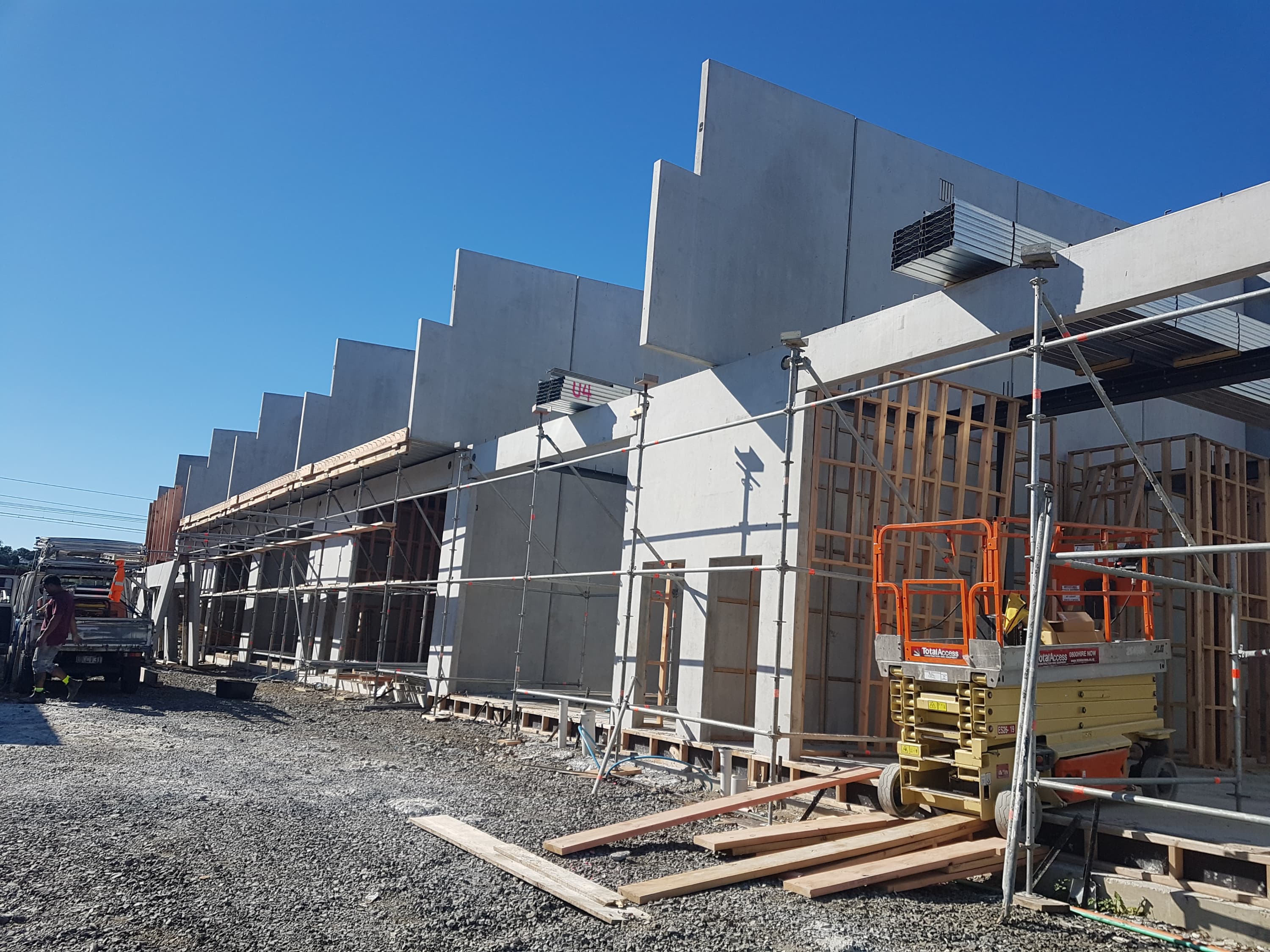
Tilt slab (also called tilt-up) panels are cast directly on the building's floor slab, which acts as the casting bed. Once the concrete reaches sufficient strength, a crane tilts the panels from horizontal to vertical and they are braced in place until structural connections are complete. The method is widely used for industrial sheds, warehouses, and single-storey commercial buildings because it requires minimal off-site infrastructure and can move extremely quickly once the floor is down.
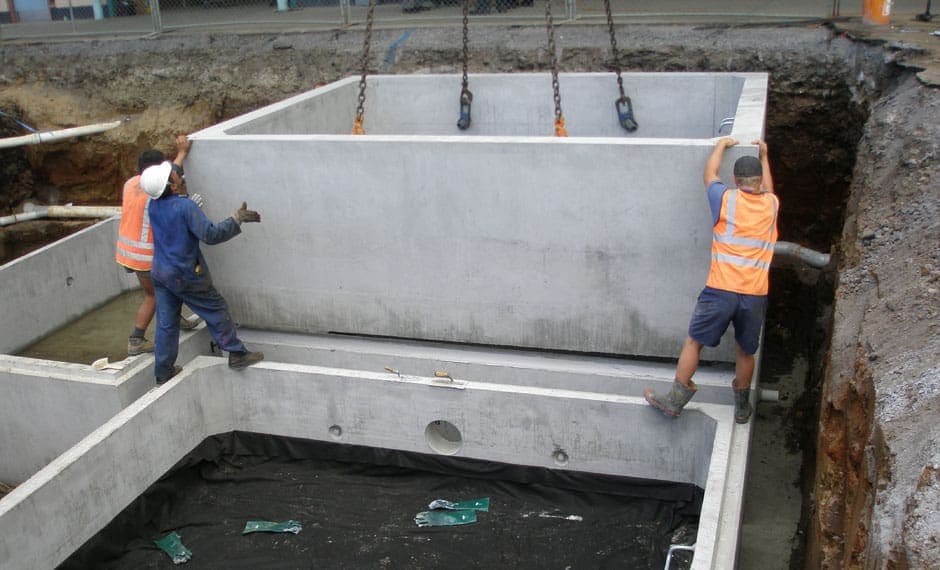
Factory precast panels are manufactured at a controlled production facility, then transported to site by truck. Precast plants maintain tight tolerances, purpose-built formwork, consistent curing conditions, and quality assurance systems that are difficult to replicate in the field. The trade-off is transport cost, panel size limits imposed by road rules, and lead time from order to delivery.
On-site precast sits between the two. A dedicated casting yard is established within or adjacent to the site — panels are formed, cast, and cured there before being craned into position. This approach makes most sense when transport from a factory is prohibitively expensive (remote locations, oversized panels) or when a project involves a large volume of repeated elements that justify setting up a proper yard.
The choice between these systems is rarely black and white. Site geometry, project scale, panel complexity, and regional crane and transport costs all shift the equation — sometimes in the same project.
Side-by-Side Comparison
The table below captures the key variables that typically drive the decision. Numbers are indicative for NZ conditions and will vary by region and project specifics.
| Factor | Tilt Slab | Factory Precast | On-Site Precast |
|---|---|---|---|
| Relative cost | Lowest for large projects | Moderate to high (transport adds cost) | Moderate — setup cost spread over volume |
| Programme speed | Fast once floor is poured | Longest lead time; parallel with siteworks | Medium — casting can start early |
| Minimum viable scale | ~1,000 m² floor area | Any size — efficient even for small runs | ~30+ panels to justify yard setup |
| Site space required | Large — full floor plate for casting | Minimal — just crane set-down area | Medium — casting yard plus crane access |
| Transport constraints | None — panels never leave site | Panel size and weight limited by NZTA rules | None — panels never leave site |
| Finish quality | Good — dependent on floor slab quality | Excellent — controlled plant conditions | Good to very good with experienced crew |
| Seismic connections | Ductile options available; connection design critical | Wide range of engineered connection options | Same as factory precast if properly designed |
| Architectural flexibility | Good for flat faces; complex curves difficult | High — custom formwork at plant level | Moderate — formwork reuse limits variation |
When Tilt Slab Wins
Tilt slab earns its dominant position in NZ industrial construction because, at scale, it is genuinely difficult to beat on cost and programme. The key conditions that favour it:
- →Large floor plate. The floor slab does double duty as the casting bed — so the bigger the building, the more casting area is available and the more efficiently panels can be laid out. Buildings under approximately 1,000 m² often do not have enough floor area to make tilt slab viable.
- →Good crane access. Tilt slab depends entirely on a crane being able to reach each panel from a position outside the floor slab. Constrained urban sites, irregular shapes, or neighbouring structures that restrict crane swing can make tilt slab impractical or expensive.
- →Budget-focused industrial or warehouse use. For a standard distribution warehouse, cold store, or light manufacturing facility where wall aesthetics are secondary to cost and programme, tilt slab typically delivers the lowest cost per square metre of wall.
- →Simple rectangular geometry. Tilt slab panels are cast flat. Reveals, recesses, and embeds can be added, but complex curved or faceted geometry is genuinely difficult to achieve without substantial additional cost.
In the Waikato and Bay of Plenty, where greenfield industrial development is common and sites tend to be generous, tilt slab makes up the majority of new commercial construction. The combination of flat land, good crane access roads, and straightforward building programmes plays directly to its strengths.
When Factory Precast Wins
Factory precast panels justify their higher unit cost in specific conditions where the quality, geometry, or site constraints of tilt slab become liabilities:
- →Complex architectural geometry. Curved facades, deep reveals, intricate surface textures, and precise dimensional tolerances are all easier to achieve in a controlled plant environment. Factory precast suppliers in NZ have invested in purpose-built formwork systems that simply cannot be economically replicated on a construction site.
- →Small or constrained sites. If there is no room to cast panels on-site — inner-city infill, sites surrounded by existing structures, or tight urban lots — factory precast delivers panels just-in-time and the crane can erect them directly from the truck.
- →Quality-critical applications. Structural elements where surface finish, concrete strength consistency, and reinforcement placement tolerances are critical — retaining walls in seismic zones, bridge components, and elements with exposed architectural concrete — benefit from plant-level quality assurance that is difficult to achieve in the field.
- →Spans beyond tilt slab limits. Very tall panels, particularly those exceeding around 10–12 metres in height, can challenge tilt slab methodology from both a structural and practical standpoint. Factory precast elements can be designed for larger spans and more complex load paths.
- →Programme sequencing advantages. Because precast panels are manufactured off-site, they can be ordered and produced while civil works and foundations are still underway. On a fast-tracked project, this parallel workstream can compress the overall programme even if the panels themselves take longer to produce than tilt slab would.
When On-Site Precast Wins
On-site precast is the least-discussed of the three options but has a clear niche in the NZ market:
- →Remote or rural locations. Transport from Auckland, Hamilton, or Christchurch precast plants to a Northland farm infrastructure project or a Central Otago commercial building can add significant cost per panel. Establishing a small casting yard on-site with a local concrete supply eliminates that entirely.
- →Oversized panels. NZTA transport rules impose width, height, and mass limits on road loads. Panels that would exceed those limits — very large retaining wall sections, for example — can be cast on-site without any transport constraints.
- →High volumes of repeated elements. If a project involves 60 or 80 identical panels, the labour to set up and reuse formwork on-site can be amortised effectively, and the savings over factory precast transport can be significant.
On-site precast is often overlooked in the tilt slab vs factory precast conversation, but for large remote projects it can be the most cost-effective solution by a meaningful margin.
NZ-Specific Factors That Shift the Equation
New Zealand's geography and construction market create conditions that differ meaningfully from Australia or the US, where much of the published guidance on these systems originates.
Crane hire costs vary significantly by region. In Auckland and Christchurch, crane availability is good and daily rates are competitive. In provincial centres — Gisborne, Greymouth, Invercargill — crane availability is tighter and mobilisation costs are higher. Tilt slab requires the crane on-site for longer than factory precast erection, so regional crane economics genuinely affect the comparison.
Transport limits on panel size. Standard transport rules allow loads up to 3.1 metres wide and 4.25 metres high without a permit, with oversize permits available up to around 5 metres wide (route-dependent). This caps factory precast panel dimensions meaningfully for some applications, particularly tall industrial walls. On-site options — whether tilt slab or on-site precast — are unconstrained in this regard.
Seismic design requirements. New Zealand's seismic environment means the structural connections between precast panels and foundations, roof diaphragms, and adjacent panels are a significant design and cost consideration regardless of which system is used. NZ engineers have developed well-understood connection details for both tilt slab and precast, but the specific seismic zone and building importance category will influence which system's connection options are more cost-effective to engineer and build.
Precast manufacturing capacity. NZ has a handful of established precast manufacturers — primarily concentrated in the main centres. Lead times for factory precast can extend to 12–16 weeks during busy periods. Tilt slab and on-site precast, by contrast, are scheduled around the project's own timeline and are not subject to plant booking queues.
Hybrid Approaches: Using Both Systems on One Project
The framing of "which system" sometimes obscures the fact that many successful commercial projects use both. A common hybrid on larger NZ industrial developments:
- →Tilt slab for the main warehouse body — large, repetitive, straightforward geometry where it excels on cost and speed.
- →Factory precast for the office or showroom frontage — where architectural finish, more complex geometry, and a higher-quality appearance justify the additional cost.
- →Precast structural elements (beams, columns, stairs) combined with tilt slab walls — leveraging factory quality control for the load-bearing structure while keeping wall costs down.
The key is that the decision should be made element by element, not applied uniformly across the whole building. A good contractor will flag where the cost-quality trade-off shifts and recommend accordingly.
How NZ Concrete Group Approaches This Decision
We have built with all three systems — tilt slab, factory precast, and on-site precast — across commercial, industrial, and infrastructure projects in New Zealand and Australia. Our starting point is always the same: what is the actual driver for this project?
If the client's primary constraint is budget and the site suits it, tilt slab is almost always the right answer. If programme sequencing is critical and the site is constrained, we will lean toward factory precast and work with our preferred suppliers to get panels into the programme early. If the project is remote and volume justifies it, we will price on-site precast alongside the other options so the client can see the actual cost difference.
What we try to avoid is defaulting to one system because it is familiar. Every project has different constraints and the concrete construction industry has genuinely good solutions for a wide range of conditions — the work is matching the right solution to the specific job.
If you are at the early stage of planning a commercial or industrial build and want a direct conversation about which system makes sense for your site and budget, our team is happy to work through that with you before you commit to a structural system. The earlier this conversation happens, the more options are on the table.
NZ Concrete Group
Family-owned concrete construction specialists based in Hamilton, Waikato. Over 30 years building concrete homes and commercial structures across New Zealand and Australia.
Not Sure Which System Suits Your Project?
Our team has built with both systems across NZ and Australia. Let us help you make the right call for your budget and programme.