


Subdivision Civil Works in New Zealand: What Concrete and Civil Work Is Involved?
Subdivision development in New Zealand involves a significant amount of civil and concrete work that is easy to underestimate at the planning stage. Here is a clear breakdown of what is typically required, what drives the cost, and what to look for in a civil concrete contractor.
What Does Civil Works Mean in a New Zealand Subdivision?
In a New Zealand subdivision context, civil works covers everything that sits between the raw land and a title-ready lot. That includes bulk earthworks, roading, drainage, water and wastewater services, retaining structures, and the concrete infrastructure required to connect each lot to the network. It is work that happens before — and often well after — the first shovel goes in the ground.
The scope varies considerably depending on the site. A flat greenfield site in the Waikato with good ground conditions and existing infrastructure nearby can have relatively modest civil costs. A hillside site in Wellington or a tight infill subdivision in Auckland with complex drainage constraints can involve civil budgets that match or exceed the construction costs of the houses themselves.
Understanding what is involved early — before you have committed to a purchase or fixed your pricing — is one of the most important things a developer can do. Civil surprises mid-project are among the most common reasons subdivision developments run over budget and over time.
Retaining Walls: When They Are Needed and What They Cost
Retaining walls are required whenever you are cutting or filling ground to create level building platforms, roads, or driveways. In New Zealand, where many desirable development sites sit on sloping terrain, retaining is often one of the largest single line items in a subdivision civil budget.
The most common types used in subdivision work include:
- →Gravity retaining walls — rely on their own mass to resist soil pressure. Concrete block or precast concrete units are typical. Suitable for walls up to around 1.5 m in height without the same engineering requirements as taller structures.
- →Cantilever retaining walls — reinforced concrete walls designed by a structural engineer. Used for walls typically from 1.5 m upwards, where the wall acts as a vertical cantilever fixed at the base. Common in residential and commercial subdivision work across New Zealand.
- →MSE (Mechanically Stabilised Earth) walls — reinforced fill structures that use geosynthetic layers to create a stable mass. Well suited to longer runs of moderate height and can be more cost-effective than concrete retaining at scale.
Consent requirements for retaining walls are triggered at different heights depending on your district plan. Most councils require a building consent for retaining walls over 1.5 m, and an engineer's design is typically required alongside it. Walls that retain more than 1 m of ground within 1.5 m of a boundary will also often require neighbour notification or a resource consent condition.
Retaining walls in a subdivision are not a contingency item — they should be costed and engineered from day one. Budget underruns here are rare; budget overruns are common.
As a rough guide, structural concrete retaining in New Zealand runs from around $1,500 to $3,500 per linear metre depending on height, ground conditions, access, and specification. A hillside subdivision with multiple lots can easily require hundreds of linear metres of retaining across the development.
Concrete Infrastructure: Driveways, Crossings, Kerb and Channel, Footpaths
Subdivision consent conditions typically specify the standard of roading and concrete infrastructure required to vest the development. Councils across New Zealand have their own engineering standards, but common requirements include:
- →Kerb and channel — poured in-situ concrete or precast, running along the edge of internal roads to direct stormwater and define the carriageway. Most councils specify a standard profile and depth.
- →Concrete footpaths — required along at least one side of internal roads in most urban subdivisions. Typically 100 mm thick reinforced concrete with a broom finish and control joints at specified intervals.
- →Vehicle crossings — the apron from the road to each lot. Concrete is the standard material for council-vested crossings and must be constructed to the approved profile and dimensions.
- →Shared driveways and accessways — common in infill and smaller subdivisions where rear lots share access. Typically specified in reinforced concrete with design loads to accommodate service vehicles and rubbish trucks.
Getting the specification right on concrete infrastructure matters not just for consent but for durability. Concrete that is poured to the wrong thickness, with inadequate reinforcement or poor jointing, will crack and deteriorate before the development is even finished. It is worth understanding your council's construction standards upfront rather than value-engineering concrete thickness on infrastructure that will need to last decades.
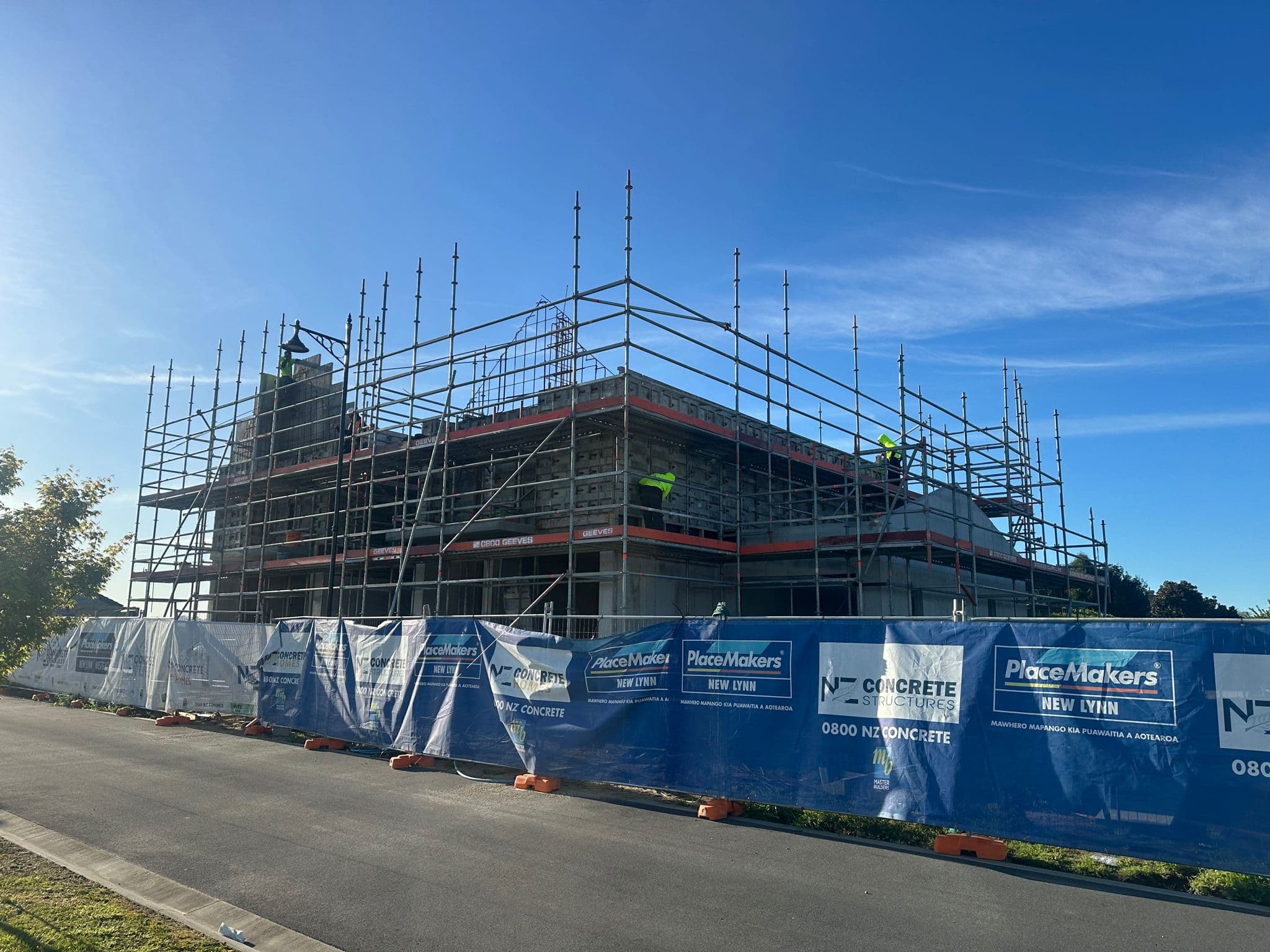
Foundation Considerations Across New Zealand Regions
Ground conditions in New Zealand vary dramatically — from stable alluvial soils in the Waikato to expansive clays in parts of Hawke's Bay, soft peat in low-lying coastal areas, and volcanic soils in Auckland and the central North Island. Getting a geotechnical investigation done before you price lots or commit to a construction budget is not optional — it is essential.
A geotech report will typically determine the allowable bearing capacity of the soil, identify any fill or contamination issues, flag liquefaction or slope stability risk, and recommend a foundation system. For individual lots within a subdivision, this informs whether standard slab-on-grade construction is appropriate or whether piled, raft, or other engineered foundations are required.
The difference between a standard concrete slab and a piled foundation can be $15,000 to $40,000 per lot depending on the pile type and depth. Across a ten-lot subdivision, a missed geotech requirement can turn a profitable project into a loss. Developers who skip geotech to save $3,000 to $5,000 in investigation costs regularly expose themselves to far larger risks.
Never price lots without a geotech report. Ground conditions are the single biggest source of unforeseen cost in New Zealand subdivision development.
NZ Concrete Group works closely with geotechnical engineers during the design phase to ensure foundation specifications are practical and buildable, not just theoretically compliant. There is a significant difference between a geotech-specified foundation and one that has been reviewed by an experienced concrete contractor for constructability and cost.
Drainage and Stormwater: Concrete Structures Required
Stormwater management is one of the most heavily regulated aspects of subdivision development in New Zealand. Under the Resource Management Act and district plan requirements, developers are required to manage stormwater to pre-development levels or better. That means designing for attenuation, treatment, and disposal — and constructing the infrastructure to deliver it.
Concrete plays a central role in stormwater infrastructure. Common structures required in a subdivision include:
- →Precast concrete manholes — installed at junctions, changes of direction, and regular intervals along the stormwater and wastewater networks. Sized to council standard and installed to design invert levels.
- →Concrete headwalls — at pipe outlets to watercourses or detention areas. Required to prevent scour and must typically be designed to handle the design flow event specified in the consent.
- →Culverts — where internal roads cross existing drainage features. Typically reinforced concrete pipe or box culverts, sized by a drainage engineer and installed to the consent drawings.
- →Detention and retention structures — in some cases concrete tanks or wet pond structures are required where piped attenuation is needed. These are increasingly common as impervious area limits tighten under district plans.
Drainage design must be completed and peer-reviewed before consent is granted in most jurisdictions. The drainage engineer's design then flows through to the civil contractor's construction drawings. Any discrepancy between design intent and what is actually built can cause as-built failures and delay the vesting of infrastructure to council.
Working with Council: Consent Conditions, As-Builts, and Vesting
Civil works in a subdivision are not complete when the concrete is poured. They are complete when the infrastructure has been inspected, as-built plans have been accepted, and the council has confirmed that it will vest the works as public infrastructure. This process can take weeks or months and is frequently a cause of settlement delays on subdivision titles.
Consent conditions for civil works typically require:
- →Construction to the approved engineering drawings and council engineering standards
- →Inspection by a council-approved inspector at key stages (foundations, drainage, concrete)
- →As-built survey and drawings prepared by a licensed cadastral surveyor confirming what was built versus what was designed
- →Producer statements from the civil contractor and structural engineer confirming the works were constructed in accordance with the consent and design
- →A maintenance period (typically one to two years) during which defects must be remedied before final vesting
Working with a civil concrete contractor who understands this process — and has a track record of completing as-built documentation correctly — saves significant time at the back end of a project. Defective as-builts or missing producer statements are frustratingly common causes of settlement delays.
How Civil Works Costs Are Typically Structured
Civil works costs in a subdivision are often presented as a mix of fixed price and provisional sum items. Understanding the difference matters for your development budget and your risk exposure.
Fixed price items are those where the scope and specification are fully defined at the time of contract. Concrete kerb and channel, footpaths, and crossings that have been designed to a confirmed grade and alignment can typically be priced firmly. The contractor takes the risk on any cost variations within that scope.
Provisional sum items are used where the final scope cannot be defined until construction is underway — typically earthworks, retaining in variable ground, and drainage where there is uncertainty about depths or ground conditions. The provisional sum is your best estimate at the time of contract; the actual cost is measured on completion.
A contract with a large proportion of provisional sums is a contract with a large proportion of cost uncertainty. The more investigation you do upfront, the more you can fix-price, and the more accurately you can budget.
Many developers make the mistake of treating provisional sums as a fixed budget ceiling rather than an estimate. Spending time and money on geotech, drainage design, and engineering before you go to contract reduces the provisional sum component and gives you a much more reliable total cost picture.
Common Mistakes Developers Make on Civil Works
After working on subdivision projects across New Zealand for over three decades, these are the mistakes we see most consistently:
- →Underestimating retaining. Retaining walls often cost more than expected because the full extent is not mapped until detailed earthworks design is done. Developers who price retaining from a site visit without an engineering survey consistently underestimate.
- →Skipping or delaying geotech. Ground conditions determine foundation cost. Discovering poor ground after you have committed to a purchase price or a fixed price contract is one of the most damaging positions a developer can be in.
- →Inadequate drainage design. Stormwater consent conditions have tightened significantly across New Zealand councils. Drainage designed to the minimum required standard can lead to consent refusals or expensive redesigns mid-project.
- →Not engaging civil contractors early enough. Civil costs are heavily influenced by design decisions made at the planning stage. Engaging a civil contractor for early cost feedback before the design is locked in can save substantial money.
- →Treating civil works as a single lump sum. Civil and concrete works involve multiple trades, materials, and inspection stages. A contractor who quotes a single lump sum without a detailed breakdown gives you no ability to assess value or manage variations.
- →Ignoring as-built requirements. The documentation required to vest infrastructure is not optional — it is a condition of your subdivision consent. Contractors who do not have systems for capturing as-built information accurately will delay your titles.
The common thread across all of these is insufficient planning before committing to costs. Subdivision development is a capital-intensive, consent-constrained activity — the more clearly you understand what the civil works will involve and what they will cost before you start, the better positioned you are to deliver a profitable project.
NZ Concrete Group
Family-owned concrete construction specialists based in Hamilton, Waikato. Over 30 years building concrete homes and commercial structures across New Zealand and Australia.
Concrete and Civil Works for Your Subdivision
Talk to NZ Concrete Group about retaining walls, foundations, and civil concrete works for your development project.