

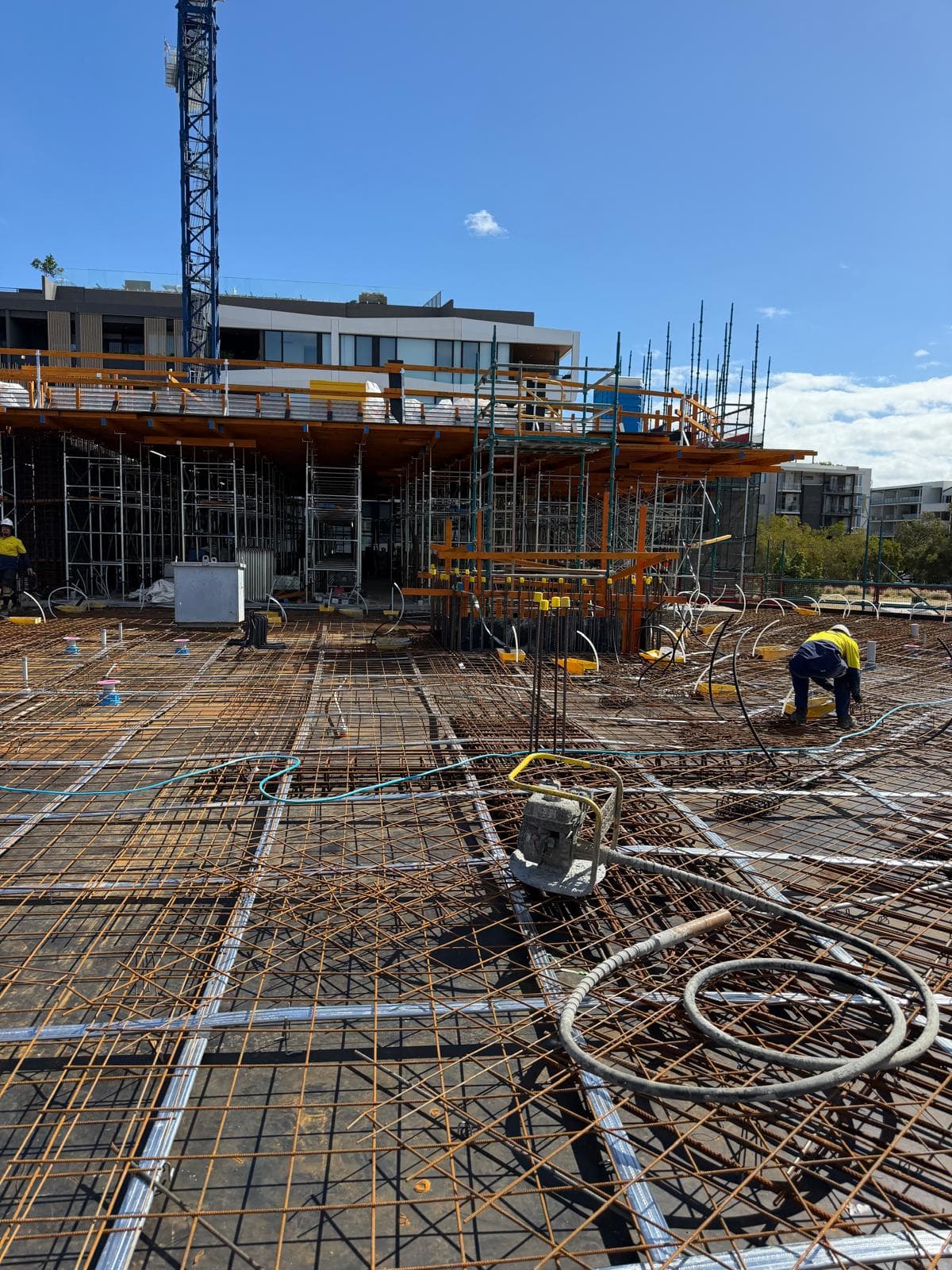
High Rise and Multi-Storey Concrete Construction in NZ
Multi-storey and high rise concrete construction in New Zealand presents a set of technical and logistical challenges that don't exist in low-rise building. Here is what distinguishes this type of work — and what to look for in a contractor who can deliver it.
Defining "High Rise" in the NZ Context
The term "high rise" is used loosely in everyday conversation, but in the New Zealand regulatory and engineering context it carries specific meaning. Under the New Zealand Building Code and NZS 3101 (the Concrete Structures Standard), buildings are categorised partly by height and partly by their seismic performance objectives.
Generally speaking, buildings over six storeys or exceeding 18 metres in height attract more stringent structural requirements, particularly around ductile detailing and seismic performance categories. Buildings classified as Importance Level 3 or 4 — which includes many commercial buildings, hospitals, and structures with high occupancy — are subject to even stricter design and construction requirements regardless of height.
For practical purposes, multi-storey concrete construction in NZ typically begins at three to four storeys, where the structural systems, formwork approach, programme logic, and quality control requirements diverge meaningfully from a single-level commercial slab or tilt-up. At six storeys and above, the engineering and construction complexity increases substantially again.
This distinction matters because a contractor experienced in standard commercial concrete is not necessarily capable of genuine multi-storey or high-rise work. The two categories demand different equipment, different technical knowledge, and a fundamentally different construction methodology.
Structural Systems in NZ Multi-Storey Concrete
The structural system chosen for a multi-storey concrete building determines almost every other decision on the project — the formwork approach, the construction sequence, the reinforcement detailing, and the programme. There are several primary systems used in New Zealand.
Shear Walls
Shear walls are reinforced concrete walls designed to resist lateral forces — primarily seismic and wind loads. In NZ multi-storey construction, shear walls are typically located at the building perimeter or around lift and stair cores, where they can efficiently transfer lateral loads down to the foundations. The detailing of shear walls in NZ is governed by the ductility demands of our seismic zone, with boundary elements and confined zones required at the ends of walls in high-ductility designs.
Moment Frames
Moment-resisting frames use the stiffness of beam-column connections to resist lateral loads. In concrete construction, this requires carefully designed and tightly detailed beam-column joints, particularly at exterior frames where seismic demand is highest. NZ practice requires ductile moment frames to meet specific joint shear and confinement requirements under NZS 3101.
Core Walls
A concrete core — typically housing lift shafts, stair wells, and service risers — acts as the primary lateral load-resisting element in many modern multi-storey buildings. The core is often constructed ahead of the surrounding structure using jump-form or climbing-form systems, providing an early stable spine from which the rest of the building is sequenced. Core walls in NZ must satisfy coupled wall or cantilever wall ductility requirements depending on their geometry and the design approach adopted.
Post-Tensioned Slabs
Post-tensioned (PT) flat plate or flat slab systems are widely used in NZ multi-storey construction because they allow longer spans, reduced slab depths, and faster floor cycles compared to conventionally reinforced slabs. PT slabs use high-strength tendons that are stressed after the concrete reaches sufficient strength, placing the slab in compression and dramatically improving its load-carrying capacity and deflection control. The design and installation of PT systems requires specialist knowledge — tendon layout, anchorage detailing, and stressing procedures are all critical to structural performance.
The choice of structural system is not just an engineering decision — it directly determines what formwork system is viable, what the floor cycle time will be, and what specialist subcontractors are required. An experienced contractor should be involved in these discussions during the design phase, not just at tender.
Seismic Design in the NZ Context
New Zealand sits on the boundary of the Australian and Pacific tectonic plates, making it one of the most seismically active countries in the world. The Kaikoura (2016) and Christchurch (2011) earthquakes demonstrated the real-world consequences of inadequate seismic design — and drove significant updates to the NZ Building Code, NZS 3101, and engineering practice more broadly.
For multi-storey concrete construction, the key seismic design considerations are:
- →Ductility: NZ concrete structures are designed to deform significantly without collapse in a major earthquake. This requires careful detailing of reinforcement — particularly in plastic hinge zones at the base of walls and at beam ends — to ensure the concrete can sustain repeated inelastic cycles without losing load-carrying capacity.
- →Capacity design: NZ practice uses capacity design principles, where the structure is intentionally designed to yield in predictable, ductile locations (plastic hinges) rather than failing in brittle modes. This affects the sizing of columns, foundations, and connections throughout the building.
- →Performance-based seismic engineering: For significant multi-storey buildings, performance-based seismic engineering (PBSE) approaches are increasingly used, where the structure is designed to achieve specific performance targets (immediate occupancy, life safety, collapse prevention) at different earthquake intensities.
- →Connection design: Beam-column connections, wall-to-slab connections, and precast-to-insitu connections are critical failure points in seismic events. In multi-storey concrete construction, these connections require careful design, precise detailing, and rigorous quality control during construction.
The practical implication for construction is that NZ multi-storey concrete requires a higher level of reinforcement accuracy and placing precision than an equivalent building in a low-seismic country. Cover to reinforcement, bar spacing, tie leg placement, and lap splice locations all matter in ways they simply don't in standard commercial work.
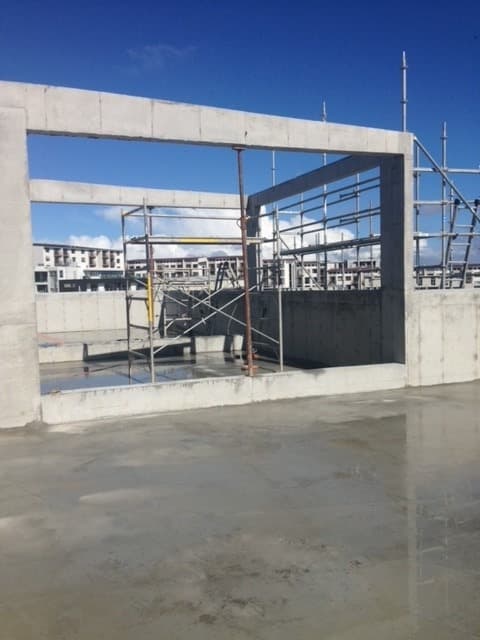
Formwork Systems for Multi-Storey Construction
Formwork selection is one of the most consequential decisions in multi-storey concrete construction. The right system directly determines floor cycle time, which in turn determines programme duration and project economics.
Jump Form
Jump form — also called self-climbing form — is used for tall vertical elements such as core walls. The formwork system hydraulically or crane-climbs up the face of the wall as each lift is completed, with the formwork panels, working platforms, and sometimes the crane climbing together. Jump form is fast, reduces crane dependency, and provides excellent access for operatives and concrete placement. It is typically cost-effective for cores above six to eight storeys.
Climbing Form
Climbing form (or crane-lifted form) is similar in principle to jump form but is repositioned using the site crane rather than a hydraulic mechanism. It is less capital-intensive than self-climbing systems and more flexible for irregular geometries, making it suitable for medium-height cores and wall elements where jump form's cost cannot be justified.
Table Form
Table form systems are used for suspended slabs. Pre-assembled formwork tables — which support the slab soffit and can include props, panels, and edge forms — are crane-flew from one floor to the next as the building rises. Table form is fast for repetitive floor plates, reduces labour significantly compared to traditional prop-and-sheet forming, and is particularly effective on post-tensioned flat slab construction where the slab geometry is consistent floor to floor.
The appropriate combination of formwork systems depends on building geometry, the structural system, crane capacity, available cranage zones, and target floor cycle. An experienced multi-storey contractor will develop the formwork strategy early in the programme, because it affects everything from crane selection to concrete pour sequence.
Concrete Mix Design for Vertical Construction
The concrete mixes used in multi-storey vertical construction differ from standard flatwork or footing mixes in several important ways.
- →Pump-ability: Almost all concrete in multi-storey construction is placed by pump. This requires a mix with adequate workability and cohesion to flow through lines, sometimes under significant pressure and over considerable horizontal and vertical distances. Aggregate size, water-cement ratio, and admixture selection all affect pump-ability.
- →Slump and flow: Higher slump mixes (or self-compacting concrete in heavily reinforced zones) are required to achieve adequate compaction around dense reinforcement cages. However, excessive slump increases bleed water, shrinkage risk, and can affect form pressure design.
- →Strength development: Floor cycle times are partly governed by when the concrete achieves sufficient strength for stripping and back-propping. Mix design — including cement type, supplementary cementitious materials, and curing approach — is optimised to achieve early strength milestones while meeting long-term durability requirements.
- →Form pressure: Concrete exerts hydrostatic pressure on formwork during placing. High-slump and self-compacting mixes exert full fluid pressure, which must be accounted for in formwork design. This is particularly important for tall wall pours.
In NZ, concrete mix design for structural work must satisfy both NZS 3101 strength requirements and the specific durability exposure classifications applicable to the building's location and use. Coastal or aggressive environments impose additional requirements on mix design, cover, and finishing.
Programme Management: The Multi-Storey Rhythm
Multi-storey concrete construction has a fundamentally different construction rhythm from low-rise building. Rather than a sequential series of distinct operations, it is a repetitive cycle — and the efficiency of that cycle determines the entire project programme.
The floor cycle time — the number of working days to complete one full floor from strip to strip — is the central metric. A well-managed multi-storey concrete project on a repetitive floor plate might achieve a five to seven day floor cycle. A poorly managed one, or one with irregular geometry or complex services, might take two to three weeks per floor. On a ten-storey building, that difference is measured in months of programme and hundreds of thousands of dollars in preliminaries.
The key programme drivers in multi-storey concrete include:
- →Crane availability — the crane is the critical resource on most multi-storey concrete sites, and formwork flying, reinforcement delivery, concrete placement, and materials handling all compete for crane time
- →Concrete strength gain — back-propping requirements mean slabs below the current floor must retain shoring until adequate strength is confirmed, constraining how far ahead the structure can be
- →Reinforcement prefabrication — pre-fabricating rebar cages off-site or in a dedicated yard can dramatically reduce on-floor placing time
- →Services coordination — penetrations, cast-in items, and MEP coordination must be resolved before each floor is formed, or programme is lost
The floor cycle is not just a construction metric — it directly sets the project's critical path. A contractor who cannot demonstrate a realistic and achievable floor cycle target, backed by formwork and resourcing logic, is not ready for genuine multi-storey concrete work.
Quality Control at Height
Quality control requirements in multi-storey concrete construction are more stringent than in standard commercial work — and the consequences of failure are proportionally greater. On a ten-storey building, a deficiency in concrete cover or compaction is not an isolated issue: it may be repeated across every floor, and its consequences accumulate over the life of the structure.
Critical quality control activities in multi-storey concrete include:
- →Concrete testing: Slump testing and cylinder sampling at point of placement (not just at the batch plant) are essential. On multi-storey work, each pour should be sampled systematically, with test cylinders cured under site conditions to reflect actual strength gain rather than laboratory conditions.
- →Cover checks: Cover meters and pre-pour inspections should verify that specified cover is being achieved at all reinforcement locations. In seismically designed structures, inadequate cover in plastic hinge zones is a serious deficiency.
- →Vibration records: Inadequate vibration of concrete during placing creates voids, honeycombing, and poor compaction around reinforcement — all invisible until the formwork is stripped. Systematic vibration records, including poker locations and vibration time, provide evidence of compliance and are increasingly required by engineers and quality auditors.
- →Reinforcement inspection: Pre-pour inspections by the contractor's QA team and the engineer of record should verify bar sizes, spacing, splice lengths, tie details, and cast-in items before each floor is poured.
- →Post-tension records: For PT slabs, stressing records — including elongation measurements compared to theoretical values — are required to verify tendon integrity and confirm that specified pre-stress levels have been achieved.
In NZ, multi-storey concrete construction typically falls within the Building Consent Authority's IQP inspection regime, and some projects engage independent peer review. A capable contractor will have structured QA documentation systems and be comfortable with the level of scrutiny that comes with this class of work.
What Distinguishes Capable Multi-Storey Contractors in NZ
The NZ concrete construction market ranges from small residential operators to large national companies. The subset capable of genuine multi-storey and high-rise concrete work is considerably smaller. Here is what separates contractors in this category from those who are not ready for this work.
- →Demonstrated project history: A contractor should be able to point to completed multi-storey concrete projects of comparable scale — not just "we've done three-storey work." Ask for project references, floor cycle records, and evidence of seismically detailed concrete construction.
- →Formwork systems and methodology: A capable contractor owns or has ready access to appropriate formwork systems — jump form, climbing form, or table form — and can describe how they will be deployed on your project. Generic prop-and-ply forming is not adequate for genuine multi-storey work at pace.
- →Suitably qualified supervisors: Multi-storey concrete requires supervisors with specific knowledge of post-tension systems, seismic detailing, concrete pump operations, and formwork engineering. These skills are not common, and their absence on a project creates significant risk.
- →Structured QA systems: ISO 9001 certification or equivalent internal QA systems, with documented inspection and test plans, hold points, and records management. This is standard on any credible multi-storey concrete project in NZ.
- →Trans-Tasman experience: Some of the most relevant multi-storey concrete experience in NZ has been gained by contractors working across both NZ and Australia. The Australian market — particularly in Queensland and NSW — has a higher volume of mid-rise concrete construction, and contractors with cross-Tasman exposure bring that scale of experience back to NZ projects.
NZ Concrete Group has delivered multi-storey concrete structures across both New Zealand and Australia, giving our teams exposure to high-volume construction rhythms and demanding quality regimes that inform how we approach every multi-storey project we build in NZ.
NZ Concrete Group
Family-owned concrete construction specialists based in Hamilton, Waikato. Over 30 years building concrete homes and commercial structures across New Zealand and Australia.
Multi-Storey Concrete Construction in NZ
NZ Concrete Group's specialist teams have delivered multi-storey concrete construction across NZ and Australia. Talk to us about your project.